 Canada

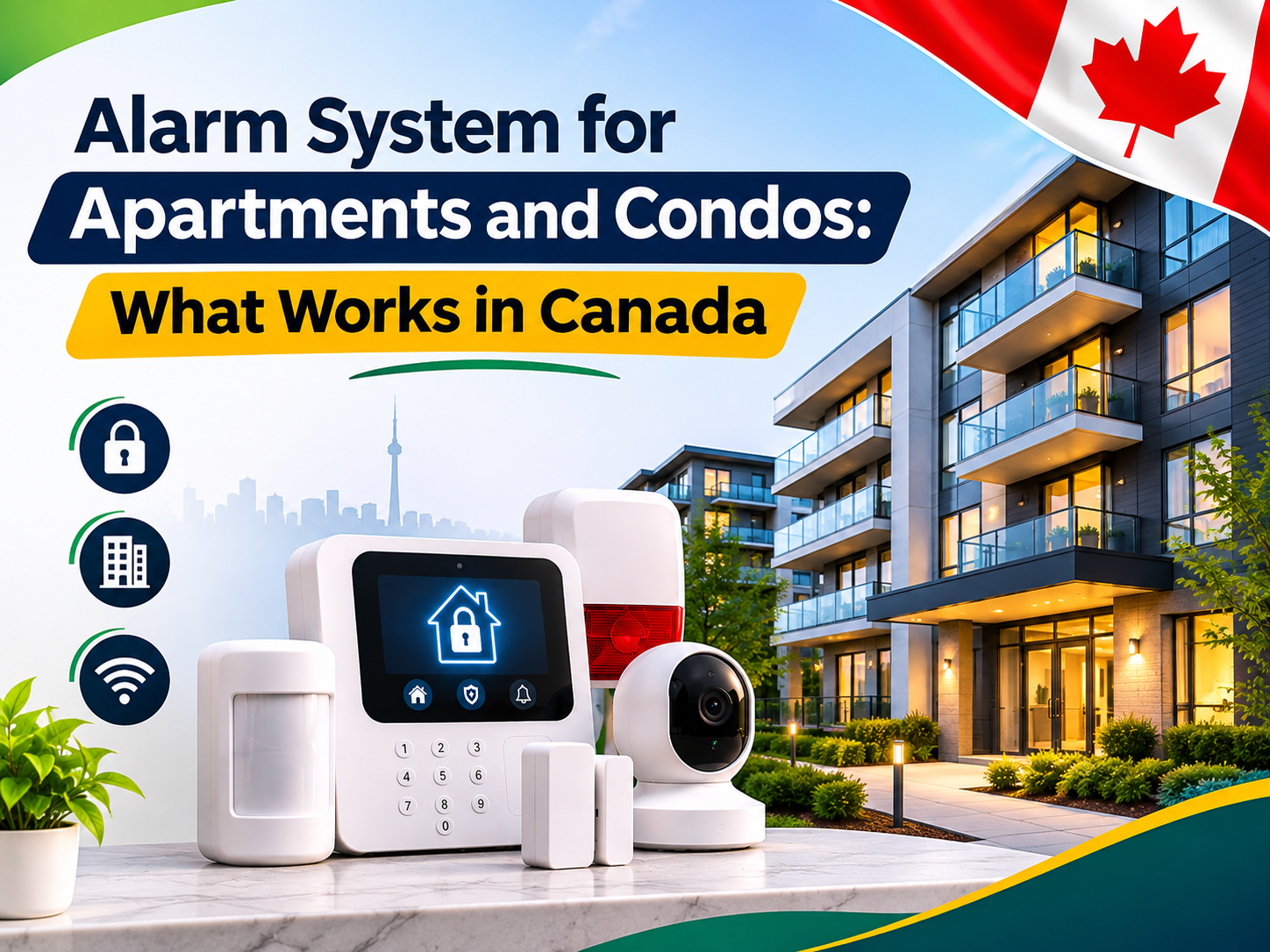
Most home alarm and security advice is based on the premise that you have a private home with a front yard, rear yard and no neighbors to ask permission from. The life of an apartment dwelling and condo dweller is not the same. You live in an apartment complex with dozens of neighbors, and possibly a lobby. It might not be feasible to bore holes into the door frame. Your front door may be the only true doorway and it leads to a corridor that you do not manage.
This makes the concept of a good apartment or condo alarm system different. This guide discusses what does and doesn't work in Canadian buildings, what to do before you do anything else, and what not to waste money on. You might want to get the simple details first, then our how a home alarm system works page explains all in layman's terms.
Should Condos and Apartment Units Have An Alarm?
It's a legitimate question, because it seems like security does its job. However, the building is protected by lobby doors, fobs and cameras, not your unit! Some of the risks in multi-unit buildings are:
- Tailgating: someone walks behind a resident through the secure door
- Lower-level units and balcony units may have access from the outside
- Theft of packages in mailroom/lobbies.
- Hallway access to your door – time and cover for an intruder after he/she is in the building.
- Water and fire hazards, from your unit or your neighbours' unit
The final line of defence: your own front door – and what happens within your unit when you are at work, travelling or sleeping.
Begin with Your Lease or Condo Rules!
If you're going to purchase anything, verify what you can do! This is the one thing that most guides overlook and may save you the trouble and money of fighting with your guide.
| Situation | What to Check |
|---|---|
| Renting | Your lease and your landlord's consent – particularly where attached to walls or doors |
| Condo owner | Whether or not changes to the doors/exteriors require board approval, and your condominium's declaration and rules |
| Cameras outside your door | If there are hallway facing cameras or not. These can cause problems regarding privacy in the eyes of neighbours and visitors. |
| Balcony devices | Whether balcony sensors or cameras are restricted |
| Smart locks | The status of the door as common property and who can change the lock |
The rules differ in each province, building and lease, so please ask, in writing, if you have any questions. As a rule, the easier and quicker to get approval are the indoor, non-invasive pieces of equipment. If a camera is recording a shared hallway, then it's much more likely to be an issue than a camera aimed at the inside of your own entrance.
What Works Best in an Apartment or Condo
1. A Wireless or Renter-Friendly Alarm Kit
Wireless alarm systems work good in apartments and condos as they require no drilling, or minimal drilling. Sensors adhere to the surface and the control panel is plugged into a power outlet. This makes it easy to install and ensures your deposit remains secure when you're renting. The system can be portable in many cases when moving. Our Wireless vs Wired Alarm Systems guide covers the difference between the two types of alarms in Canadian homes, even condos.
2. A Small, Well-Placed Sensor Set
A 700 square feet unit doesn't require a sensor for everything. A rational set for the majority of apartments is:
- Installing door contact sensor on main entry door.
- Any ground floor windows or door/ window sensors on a balcony door.
- A motion detector that covers the main living area or hallway.
- Provide smoke and carbon monoxide detection, if not already provided by the building.
- A water leak sensor under the kitchen sink, near the washer or by the water heater
For example, the potential for water leaks is easy to forget. You don't want to cause damage to your unit and the units below, and in a condo it can become complicated with the cost and responsibility. A leak sensor is an excellent value add and is very often one of the most useful.
3. Professional Monitoring or Self-Monitoring
| Option | How It Works | Best For |
|---|---|---|
| Professional monitoring | A staffed centre will be alerted and then call you and emergency services. | Those on the move, working odd hours or wanting to get in touch when they're not available. |
| Self-monitoring | You are alerted to your phone and you make a choice as to what you do. | Individuals who are always available and desire reduced recurring expenses. |
There's one more thing to consider in a building—when you're located far away, you can't easily monitor your unit yourself. When you can't, there is professional monitoring! Be sure to select a monitoring plan that is available in your province – availability and language support varies, especially in Quebec.
4. Reliable Communication
An alarm that requires internet connectivity to communicate through, could be silent if the internet or building's power goes out. Try to find cellular communication either as primary or as a secondary means. Learn about landline, internet, and cellular signals with our guide to types of home alarm systems.
5. A Doorbell or Indoor Camera (Optional)
Including a picture is helpful. A video doorbell lets you see who's at your doorstep and an indoor camera trained at the front door lets you know what triggered an alarm. Point it at your own space! See our comparison of an alarm system vs security cameras if you don't know whether you need one or not.
Features That Matter Less in a Small Space
- Dozens of sensors: there are no advantages to having more in a studio or one-bedroom. more is not better.
- Outdoor cameras and floodlights: often not permitted, and usually not needed
- Large, hardwired setups: hard to justify when you might move or can't drill
- Pricey add-ons you won't use: smart lighting packages, extra keypads, and extra sirens
Apartment, Condo, or Townhouse: What Changes?
| Home Type | Typical Approach |
|---|---|
| Rental apartment | These portable wireless kits are suitable for no permanent fixtures, with permission from the landlord and adhesive sensors. |
| Condo you own | Wire/hybrid system, check board rules, monitor and water protection. |
| Ground-floor or balcony unit | More sensors on doors and windows, glass break detection, balcony doors and windows covered. |
| Top-floor or high-rise unit | Concentrate on entry door, smoke protection, CO protection and water protection. |
| Basement or lower-level suite | Water Sensors and communication path, Window Coverage. |
How The Picture Changes During Canadian Winters and Buildings.
- Power outages: during a winter storm, the power can go out at a building and elevators and Wi-Fi could be down. Your alarm is equipped with back-up battery and cellular communications.
- Cold balconies: balcony doors are subjected to high fluctuations in temperature, which is a challenge for their sensors. Select equipment suitable for them; inspect batteries prior to winter.
- Thick concrete walls: a lot of high-rise condos have concrete floors and walls which impede wireless signals. When deploying sensors, verify the signal strength; or ask for equipment capable of operating effectively in such conditions.
- Frozen pipes and heating failures: the low temperature alerts will alert you before the burst pipe becomes a flood.
Respect For Neighbours and Privacy.
When sharing a building, your equipment has an impact on others. Here are a couple of good habits to get into:
- Avoid photographing people's doors and hallways, or yourself.
- Securely use passwords and 2fa for all applications/cameras.
- Maintain up to date software and firmware.
- Be familiar with storage locations and storage duration of the footage
- Avoid recording voices in the neighbourhood areas.
Cost: What to Compare Without Chasing a Headline Price
The cost varies depending on the provider and configuration – take the big picture:
- Equipment: Control panel, sensor(s) and camera(s) (if available).
- Installation: Free, paid or DIY
- Monitoring: A variety of monitoring options are available, such as monthly or annual fees, as well as the type of monitoring provided.
- Cloud storage: If you're using cameras, make sure to use cloud storage.
- Contract terms: what are the terms of your contracts, how long they are in effect, if there are any cancellation fees, etc.
Get quotes in Canadian dollars including taxes. Some insurers will be willing to offer good rates on monitored systems, but that's dependent on the kind of insurance policy and the insurance company - don't assume that just because you have a monitored system you're covered for a good rate, check with the insurance company. Tenants could also ask if their tenant insurance covers fires.
A Simple 6-Step Checklist
- Check your lease or condo rules and obtain written approval if necessary.
- Walk through your unit and observe the entry door, balcony, ground floor windows and water sources.
- Select wireless or renter-friendly system, small, focused sensor set.
- Determine a monitoring option, and check if it is offered in your province.
- Use a reliable method of communication, preferably cell phone or dual path.
- Test all equipment after setup, and record equipment for moving.
Once you know the basics, for a wider comparison, check out our best alarm system for Canadian homeowners page.
Common Mistakes
- Purchasing a system built for a large house.
- Not adhering to the rules of the lease or condo when installing equipment.
- Not having a backup power source for outages when using Wi-Fi connections
- Omitting water or smoke protection.
- Using a camera to capture images of the hallway or a next door neighbour's door.
- When you assume the security of a building you are making your unit safe.
Final Verdict
The ideal alarm system for an apartment or condo is small, wireless and focused: protected front door and balcony, some smart sensors, smoke and water protection, dependable communication and monitoring that meets one's lifestyle. There's no need for a house-sized installation, but don't necessarily take for granted that the building will take care of itself.
Whether you are an apartment or condo owner or a renter, at United Security we have the answers and no unnecessary equipment to fit your space, rules of your apartment/condo and your budget. We're willing to help you get your system protected without over-buying or breaking the rules, without drilling through the unit, and without causing harm to your unit.
Not sure which alarm setup fits your apartment or condo? Contact us at 1-800-466-3348 to speak with a security specialist today from United Security and get a free, no-obligation consultation.