 Canada

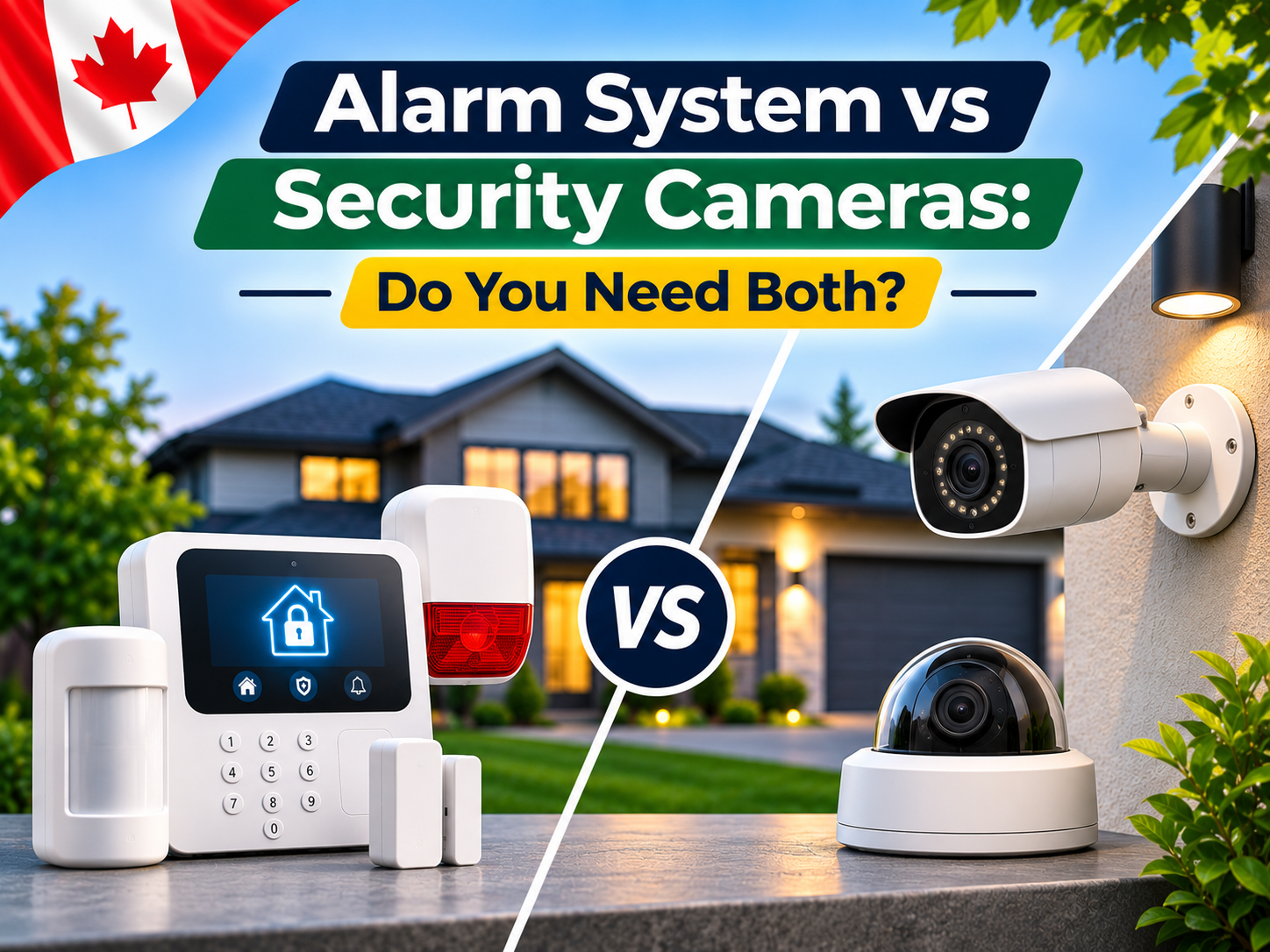
One of the most frequently asked homeowner questions again prior to purchase is if they should invest in an alarm system, security cameras or both. Typically, most articles respond with some obvious "both," and then proceed to a sales pitch. Not very useful if someone is considering which items to buy and which to forgo for their homes.
The short answer is that there are different problems that can be addressed using a security alarm and a security camera. Alarms respond and cameras take in-some homes get exposed between them. This guide provides information on what each does, where each fails and how to choose, in a Canadian winter context.
The Quick Answer
- Alarm only: protects against entry, and spurs a reaction to start, but provides minimal evidence of what occurred.
- Cameras only: does not do anything nor call anyone by itself, just shows you what happened.
- Both together: the alarm identifies, reacts, and records, the cameras identify and record. This is the better configuration for the majority of houses.
However, both does not necessarily imply a full and costly installation. A good alarm and a few judicious cameras will suffice in some homes. This guide provides the rest of the necessary information to help you figure out where you're going.
What Security Alarms Do
Security alarms are designed on detection and response. When sensors are activated on a door, window or in a room, the control panel determines if it is a true trigger or not, and the siren is activated. If the system is monitored, a signal is also sent to a staffed centre which notifies you, and, if necessary, emergency services. Our guide to home alarm systems takes you through this step-by-step.
Where alarms are strong
- They don't wait to be told that they've been entered, they know when they have been entered.
- They operate in the dark, dark rooms without a line of sight and at night when everyone is asleep
- They may feature smoke, carbon monoxide or flood sensors, and are more than just about breaking and entering.
- They can elicit a professional response, with or without you noticing the alert
Where alarms fall short
- They let you know that something started, but not what or who
- The false alarms from pets, wind or user error can be a nuisance and some cities have fees for false alarms.
- Without video, an operator can't always tell a real threat from a mistake
What Security Cameras Do
The concept of security cameras is rooted in seeing and proving. They tell you what's going on at your front door, driveway or back yard, takes pictures with the event and allows you to check in remotely. They come in many varieties, including individual smart doorbells, to comprehensive multi-camera security camera systems with recording equipment. Or, if you don't know which one is right for you, our articles on the different types of security cameras, and CCTV vs smart security cameras can help you understand them.
Where cameras are strong
- They give you clear footage for insurance claims and police reports
- They let you see what triggered an alert, and who is at the door, from anywhere
- Visible cameras can discourage opportunists
- They're useful for everyday life too: deliveries, pets, kids arriving home
Where cameras fall short
- A camera is not a siren, nor is it capable of contacting anybody by itself.
- Self-monitored cameras only assist if the notification is received before it is too late
- Noise from motion – whether trees, animals or passing cars – can become noise that you tune out.
- Cameras require electricity and require an internet connection, they can have blind spots and have difficulty in low light.
Alarm System vs Security Cameras: Side by Side
| Factor | Alarm System | Security Cameras |
|---|---|---|
| Main job | Detect entry and trigger a response | Show and record what happens |
| Works while you're asleep or away | Yes, especially if monitored | Only if alerts reach someone |
| Provides evidence | Limited (event logs) | Strong (video) |
| Covers fire, CO, and flood | Yes, with the right sensors | Generally no |
| Deters intruders | Siren, signage, response | Visible presence |
| Can confirm a real threat | Not on its own | Yes, by showing the scene |
| Relies on internet | Can use cellular backup | Usually relies on Wi-Fi |
| False alert risk | Sensors set off by pets or error | Motion alerts from wind, animals, cars |
| Typical cost drivers | Sensors, monitoring plan | Number of cameras, storage, subscriptions |
Why the Two Work Better Together
The real value of combining them isn't just coverage. It's what happens in the moments after something triggers.
- When the back door is opened, an alarm rings at 2 am.
- The camera will show you the picture so you and/or the monitoring operator can decide if it is an intruder, a pet or a family member.
- The answer is related to the problem—if the threat is real, it is a real threat, if the threat is not real, it is quickly sorted out.
- A recording is made which ensures you have a record for insurance or police.
This is known as video verification. It cuts down on false alarms, increases real ones and provides you with proof afterwards. Neither system has the capability of achieving all four tasks alone.
Failure Scenarios Most Comparisons Skip
It's helpful to examine the dysfunction in each setup to determine.
- Power or internet outage: Wi-Fi enabled cameras can cease recording or transmissions of alerts. There is a back-up battery on an alarm panel and cell communication can maintain the signals. This is a serious factor in Canadian winter storms.
- Cold weather: both wireless sensors and outdoor cameras rely on batteries or electronics which can be impacted by the extreme cold. Equipment of appropriate temperature ratings is important. Our wireless vs wired alarm systems guide addresses this concerning alarms.
- Nobody sees the alert: both self-monitored cameras and alarms are useless if you're sleeping, in a meeting or out of signal area. Professional monitoring fills in that void.
- Camera blind spots: an intruder who enters through an unmonitored window/side door will not be visible on the camera, but will be detected by an alarm sensor attached to the window/side door.
- Alarm without context: if a siren will repel him or her, at least you will have a warning, but if the person has already left, you will have nothing to show for your attempt to frighten him or her.
Which Setup Fits Your Home?
| Your Situation | A Sensible Starting Point |
|---|---|
| Condo or apartment | A wireless alarm, plus a doorbell camera or one indoor camera |
| Townhouse | Alarm with door and window coverage, plus front and back cameras |
| Detached home | Full alarm coverage, plus cameras on main entry points and driveway |
| Large property or acreage | Hybrid alarm, plus multiple outdoor cameras and good lighting |
| Frequently away or travelling | Professionally monitored alarm with video verification |
| Tight budget | Start with a monitored alarm, then add cameras over time; or reverse it if evidence and visibility matter more to you |
| Business or home office | Alarm, cameras, and monitoring working together |
Thinking About Cost Without Falling for a Headline Price
Be sure to compare the whole picture, not just the number of months, as the prices vary from provider to provider and home to home.
- Alarm costs are based on the number of sensors, control panel, installation and monitoring plan.
- The price of the camera depends on the amount of cameras, recording method, storage (local vs cloud) and subscription charges.
- The combined systems may be more efficient than purchasing separately as there is a combined application, panel and monitoring plan which eliminates duplication.
Request a quote, including the taxes, and confirm the duration and cancellation policy. Insurers may be willing to provide better rates on monitored systems, but not all insurers, and do not assume a saving—check with your own insurer.
Don't Forget Privacy
People, including visitors and neighbours, are captured on camera. Never point them at the street or another neighbour's yard instead of at your own property, always use strong passwords and two factor authentication, and keep software up to date. If you're not sure about picking, read our review of the best smart security camera.
Common Mistakes When Choosing
- Taking out the alarm and replacing it with cameras
- Purchase an alarm without making a visual inspection
- Using equipment that relies solely on Wi-Fi in the house.
- Not taking advantage of professional monitoring and opting for phone alerts only.
- Ensuring cameras are easily accessible or visible or leaves side and rear entry points unprotected
- Expensing features that have nothing to do with the use of the residence.
Final Verdict: Which is Best for You?
So when you're wondering if you should have both, the answer is yes, unless you don't want a home that is secure and protected, and you also want to have it recorded. If you need to begin with one, the monitored alarm will provide you with the greater response, and cameras will provide you with visibility and evidence. Together, they fill in the spaces left by the other two.
United Security provides home and business alarm systems, security camera systems and 24/7 monitoring throughout the GTA. We examine your property first, then suggest only what you need – simply put. For more detailed comparisons of alarm offerings, check out our article on the best alarm system for Canadian homeowners, and our article on the different types of alarm systems can explain the differences.
Not sure whether you need an alarm, cameras, or both? Contact us at 1-800-466-3348 to speak with a security specialist today from United Security and get a free, no-obligation consultation.