 Canada

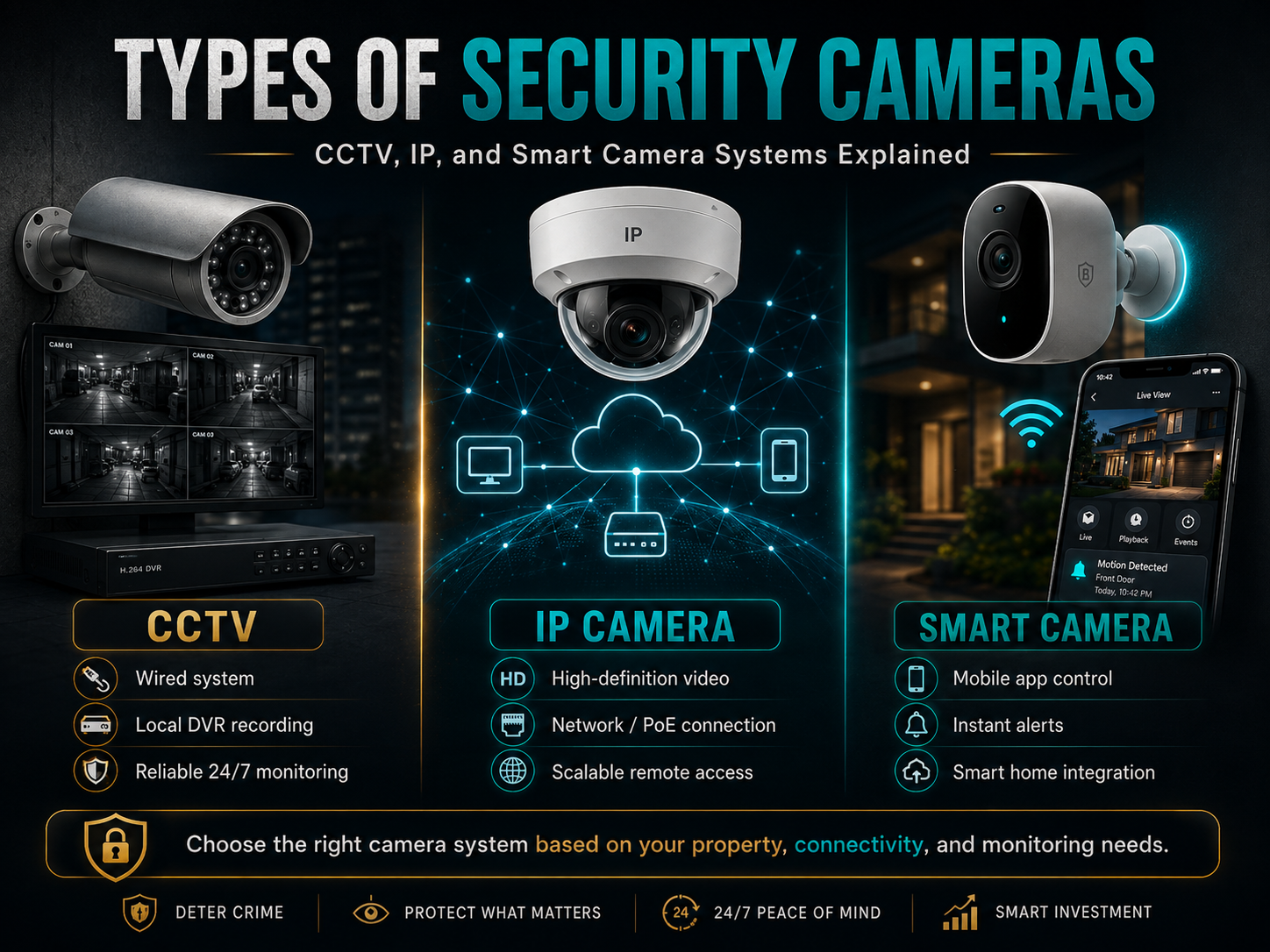
Not every security camera works the same way, and choosing the wrong type can leave you with blurry footage, missed coverage, or a system that's harder to expand later. Before deciding CCTV vs smart security cameras, it helps to understand the different technologies and camera styles available, so you know exactly what you're comparing.
This guide breaks down security cameras by connection type, camera style, and deployment, so you can choose a system that actually fits your property.
Types of Security Cameras by Connection Technology
1. Analog (CCTV) Cameras
Analog cameras are the traditional foundation of CCTV systems. They capture raw video and send it over coaxial cables to a DVR (Digital Video Recorder), which compresses and stores the footage.
- How it works: cameras connect via coaxial cable to a central DVR
- Best for: budget-friendly upgrades to existing coax wiring, straightforward installs
- Limitation: lower maximum resolution and signal quality can degrade over long cable runs
2. IP (Network) Cameras
IP, or Internet Protocol, cameras process video onboard and transmit it over a network connection to an NVR (Network Video Recorder) or cloud storage. Most modern professional installations now use IP over PoE (Power over Ethernet), sending both power and data through a single cable.
- How it works: cameras connect via Ethernet to an NVR or network, often powered through the same cable
- Best for: higher resolution needs, remote viewing, AI-based detection features
- Limitation: requires network infrastructure and, since footage travels over the internet, needs proper encryption to stay secure
3. Wireless (Wi-Fi) Cameras
Wireless cameras skip the cabling entirely, connecting to a home or business Wi-Fi network instead. They're the easiest type to install and are common in smart security camera setups.
- How it works: cameras connect to a Wi-Fi router and stream footage to an app or cloud storage
- Best for: flexible placement, smaller installations, renters or properties where running cable isn't practical
- Limitation: more prone to signal interference and generally not recommended for high-security environments
Types of Security Cameras by Style
Beyond connection type, cameras also come in different physical styles, each suited to a specific job.
| Camera Style | Best Suited For |
|---|---|
| Bullet Cameras | Long-range outdoor coverage, driveways, parking lots, perimeters |
| Dome Cameras | Indoor spaces like retail stores and offices, discreet and vandal-resistant |
| Turret Cameras | Similar to dome cameras, with improved night vision and easier angle adjustment |
| PTZ (Pan-Tilt-Zoom) Cameras | Large open areas needing active, remote-controlled monitoring |
| Video Doorbell Cameras | Front entrances, package monitoring, visitor screening |
Most well-designed camera systems combine several of these styles, using bullet cameras for perimeters, dome or turret cameras indoors, and PTZ cameras for large open spaces that need active monitoring.
Smart Security Cameras: A Feature Set, Not a Separate Technology
It's worth noting that "smart cameras" usually aren't a distinct connection type, they're typically IP or Wi-Fi cameras with added intelligence layered on top, such as:
- AI-based person, vehicle, or package detection
- Real-time push notifications
- Two-way audio
- Cloud storage with searchable footage
- Integration with smart locks, alarms, and access control systems
This is why the real decision usually isn't "CCTV vs. smart cameras" — it's choosing the right mix of connection type, camera style, and smart features for each part of your property.
DVR vs. NVR: What Powers Your System
The recorder behind your cameras matters just as much as the cameras themselves:
- DVR (Digital Video Recorder): works with analog coax cameras, a solid choice for upgrading existing wired systems
- NVR (Network Video Recorder): works with IP cameras, offering higher resolution, more storage flexibility, and easier expansion
Indoor vs. Outdoor Cameras
Where a camera is installed changes what it needs to withstand:
- Indoor cameras prioritize image clarity and blend into offices, retail floors, and living spaces
- Outdoor cameras need weatherproof, vandal-resistant housings to hold up against rain, heat, and tampering, even under a covered entryway
Which Type of Security Camera Is Right for You?
- Homeowners: wireless or IP cameras at entry points, paired with a video doorbell, cover most residential needs
- Small businesses: a mix of dome cameras indoors and bullet cameras outdoors, recorded through an NVR, balances quality and cost
- Warehouses and large commercial properties: IP camera systems with PTZ units for open areas and bullet cameras for perimeters offer the most complete coverage
- High-security facilities: wired IP or analog systems reduce reliance on Wi-Fi and lower the risk of remote interference
Final Verdict: Which is Best for You?
There's no single "best" camera type — the right system is usually a combination: the right connection technology, the right camera style for each location, and the right smart features layered on top. Matching these choices to your property's size and risk level is what actually determines how well your security system performs.
At United Security, we design camera systems around your property, not a one-size-fits-all package, combining the right camera types and recording setup for complete, reliable coverage.
Not sure which camera types fit your property? Contact us at 1-800-466-3348 to speak with a security specialist today from United Security and get a free, no-obligation consultation.