 Canada

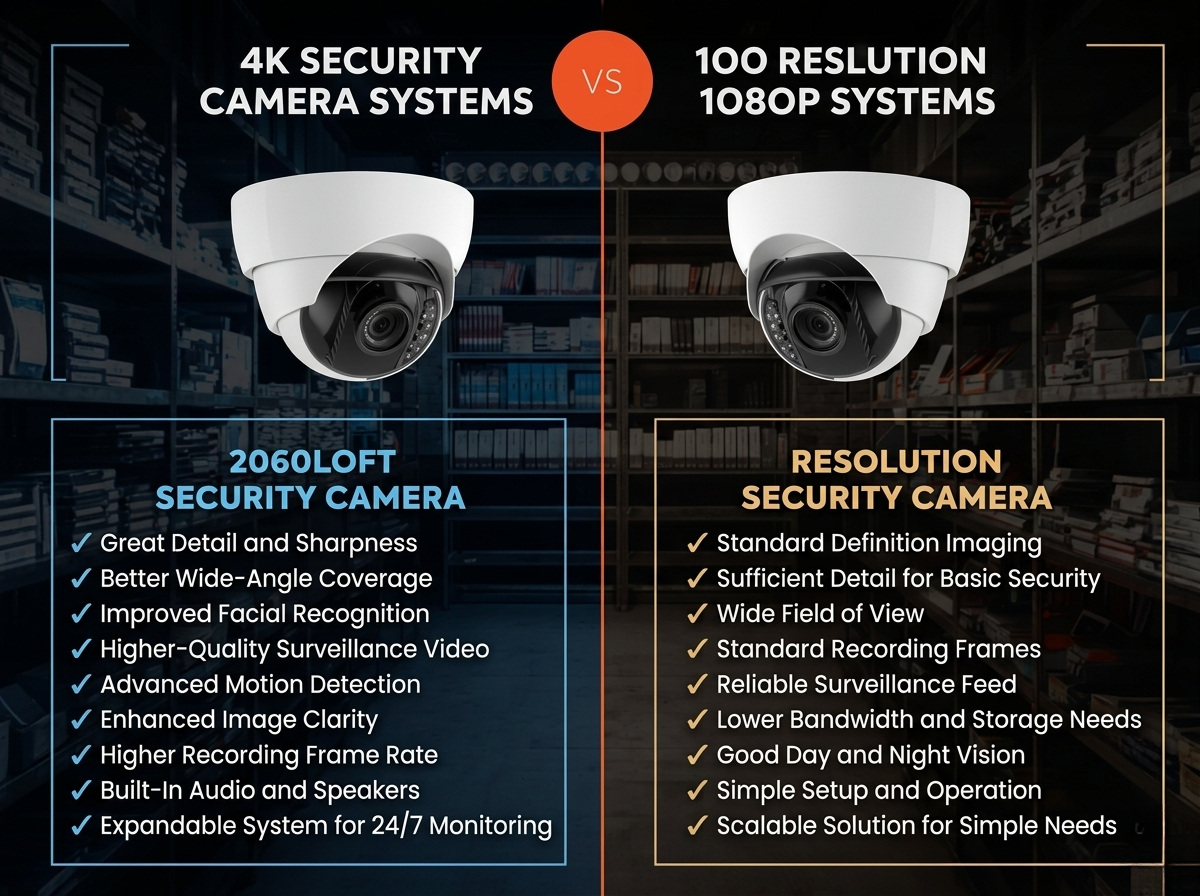
In 2026, choosing a security camera isn't just about "seeing" anymore — it's about identifying. Whether you are protecting a luxury home in Toronto or a small business in Calgary, the resolution you choose can be the difference between a blurry shape and a conviction.
But is 4K always the winner? Let's break down the 2026 reality of 4K vs. 1080p security camera systems — covering video quality, storage, bandwidth, AI features, Canadian winter performance, and total cost of ownership.
Quick Comparison: 4K vs. 1080p At a Glance (2026)
| Feature | 1080p Security System | 4K Security System |
|---|---|---|
| Resolution | 1920 x 1080 (2MP) | 3840 x 2160 (8MP) |
| Identification Distance | Up to 20 feet | 40–70+ feet |
| Bandwidth Needed | 3–5 Mbps per camera | 15–25 Mbps per camera |
| Storage (30 Days) | ~2 TB (H.265) | ~8 TB (H.265) |
| AI Capabilities | Basic Motion Detection | Advanced (Face, Pet, Plate, Package) |
The Pixel Powerhouse: 4K (Ultra HD)
A 4K camera records at 3840 x 2160 pixels — roughly 8.3 million pixels. Compare that to 1080p at 2.1 million pixels, and you're looking at 4x the detail in every frame.
- Best For: Large driveways, parking lots, and identifying faces or licence plates at 40+ feet.
- The 2026 Edge: Modern 4K systems now use AI-enhanced retinal sensors that capture eye colour and clothing textures even in low light.
- The Zoom Factor: You can digitally zoom into a 4K frame by 2x and still retain 1080p quality — impossible with standard 1080p cameras.
The Reliable Veteran: 1080p (Full HD)
1080p is still the standard for many Canadian homes because it's cost-effective and easy on your internet connection.
- Best For: Small indoor rooms under 20 feet, back porches, or narrow hallways.
- Pros: Low bandwidth consumption and lower storage costs.
- Cons: Beyond 25 feet, identifying a stranger's face becomes a real challenge.
Hidden Canadian Factors You Need to Know
1. The "Canadian Winter" Impact
Most blogs ignore that 4K sensors generate more heat during operation. In the extreme cold of a Canadian winter (-30°C), this heat can actually prevent lens fogging and internal icing better than 1080p units. However, ensure your 4K system is rated IP67 weatherproof for maximum durability across all Canadian provinces.
2. Insurance Premium Discounts
In Canada, many insurance providers offer a 5% to 15% discount on home insurance if you have a professionally monitored 4K system. Why? Because 4K footage is highly admissible in court, reducing their risk during a claim. This alone can offset a significant portion of your annual system cost.
3. H.265+ Compression Technology
The biggest complaint against 4K is storage. In 2026, you shouldn't just buy a 4K camera — you need an NVR (Network Video Recorder) that supports H.265+ compression. This technology reduces 4K file sizes by up to 50% without losing quality, making the storage gap between 4K and 1080p much smaller than it was even two years ago.
How to Choose the Right Resolution for Your Property
Step 1: Assess Your Coverage Distance
- Under 20 feet — Narrow hallways, back porches, interior garages: 1080p is perfectly adequate.
- 20–40 feet — Standard driveways, front yards, side passages: 2K minimum recommended.
- 40+ feet — Large properties, parking lots, commercial frontages: 4K is the right choice.
Step 2: Check Your Internet Bandwidth
- Under 10 Mbps upload: 1080p cameras are the practical choice for remote viewing.
- 10–25 Mbps upload: A hybrid setup (4K at key entry points, 1080p elsewhere) works well.
- 25+ Mbps upload: Full 4K system with H.265+ compression is viable and future-proof.
Step 3: Consider Your Storage Setup
| Setup | Resolution | Recommended Storage | Approx. Cost (CAD) |
|---|---|---|---|
| 4-Camera Home System | 1080p | 2 TB NVR | ~$300–$500 |
| 4-Camera Home System | 4K (H.265+) | 4–8 TB NVR | ~$600–$1,200 |
| 8-Camera Business System | 4K (H.265+) | 8–16 TB NVR | ~$1,500–$3,000 |
Our 2026 Recommendation: The Hybrid Setup
For most Canadian homeowners and small businesses, a hybrid approach delivers the best balance of performance, cost, and practicality:
- 4K cameras at main entrances, driveways, and any area where licence plate or facial identification matters.
- 1080p cameras for indoor coverage, garages, back porches, and areas with shorter monitoring distances.
This setup gives you forensic-level detail where it counts, while keeping storage, bandwidth, and costs manageable across your full system.
Professional Installation: Getting It Right the First Time
Choosing the right resolution is only part of the equation. Camera placement, cable routing, NVR configuration, and network setup all determine whether your system actually performs under pressure — or leaves blind spots you only discover after an incident.
United Security Systems has been installing professional-grade security camera systems for Canadian homes and businesses since 2004. Their certified technicians configure 4K systems with H.265+ NVRs, colour night vision, and 24/7 ULC-certified monitoring — ensuring your cameras capture exactly what they need to, every time.
| Package | Cameras | DVR/Storage | Monthly Monitoring | One-Time Option |
|---|---|---|---|---|
| Total Protection | 4 x 4K cameras | 4-ch DVR | $55.95/mo | Contact for quote |
| Total Protection Plus | 8 x 4K cameras | 8-ch DVR | $89.95/mo | ~$2,600 CAD |
| 6-Camera Package | 6 x 4K cameras | 6-ch DVR | Contact for quote | ~$2,000 CAD |
| 8-Camera Package | 8 x 4K cameras | 8-ch DVR | Contact for quote | ~$2,600 CAD |
| 12-Camera Package | 12 x 4K cameras | 12-ch DVR | Contact for quote | Call for pricing |
| Smart Home Plus | 2 HD cameras | 4-ch DVR | $69.95/mo | Contact for quote |
All monitoring packages include free professional installation, 3 months free monitoring for new customers, and $0 upfront on qualifying plans.
Final Verdict: Which is Best for You?
Choose 1080p if: You're on a strict budget, have limited upload speeds under 10 Mbps, and only need to monitor small indoor spaces or short-range exterior areas.
Choose 4K if: You want a future-proof system, need to see licence plates on the street, or want to take full advantage of AI features like person detection, facial recognition, and package alerts.
Our Recommendation: For 2026, a hybrid setup — 4K at your main entrances and driveway, 1080p for interior and secondary areas — gives Canadian homeowners the best combination of detail, storage efficiency, and value. Pair it with an H.265+ NVR and professional monitoring, and you have a system that will hold up through any Canadian winter and provide court-admissible evidence if you ever need it.
Ready to upgrade to a professionally installed 4K camera system? Contact United Security at 1-800-466-3348 to schedule a free consultation. Our certified technicians will assess your property and design the ideal 4K system — installed correctly from day one.