 Canada

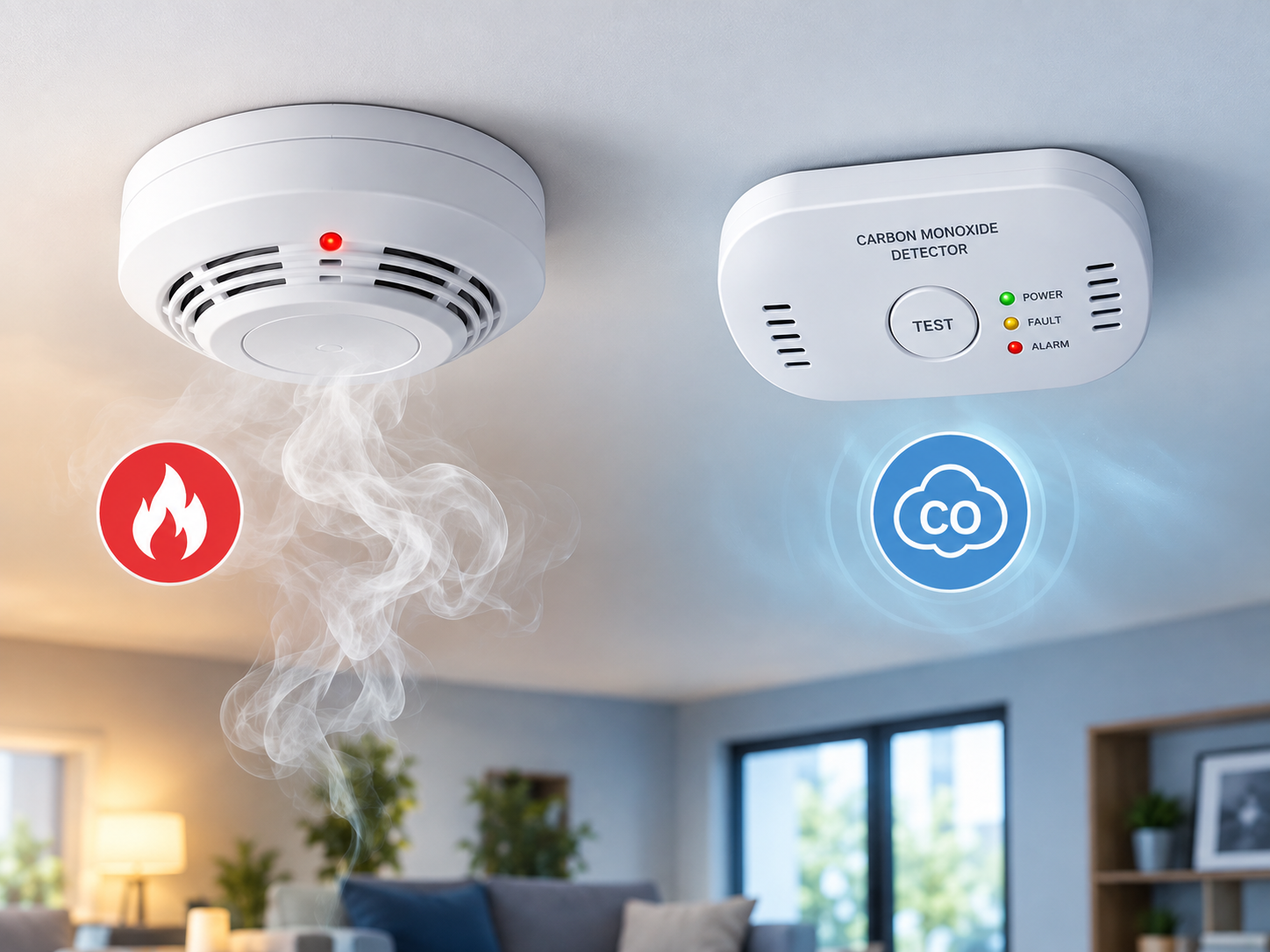
Smoke detectors and carbon monoxide detectors often look alike, sit in similar spots, and get lumped together in conversation, but they protect against two completely different dangers. Mixing them up, or assuming one covers both, is a mistake that leaves a real gap in your home's safety.
If you're shopping for either type, our guide to the best smoke detectors in Canada covers top models and what to look for, including combination units that handle both smoke and CO detection.
What Does a Smoke Detector Do?
A smoke detector senses airborne smoke particles produced by fire, giving you an early warning before flames spread or smoke inhalation becomes dangerous. Most residential smoke detectors use one of two sensing technologies:
- Photoelectric sensors: respond quickly to slow, smouldering fires, like an overheating cord or a couch fire
- Ionization sensors: respond faster to fast-flaming fires with less smoke
Many modern alarms use dual-sensor technology, combining both for broader fire detection coverage.
What Does a Carbon Monoxide Detector Do?
A carbon monoxide (CO) detector senses a completely different hazard: an invisible, odourless gas produced by incomplete combustion in fuel-burning appliances, like furnaces, water heaters, fireplaces, generators, or a car left running in an attached garage. Because CO can't be seen, smelled, or tasted, a detector is the only way to know it's building up in your home.
CO detectors typically use one of these sensor types:
- Electrochemical sensors: use a chemical reaction that produces an electrical current as CO levels rise
- Metal oxide semiconductor sensors: detect CO through changes in electrical resistance caused by heated tin oxide
Smoke Detector vs CO Detector: Key Differences
| Factor | Smoke Detector | Carbon Monoxide Detector |
|---|---|---|
| Detects | Smoke and fire particles | Carbon monoxide gas |
| Danger source | Fires, flames, smouldering materials | Fuel-burning appliances, blocked vents, running vehicles |
| Detectable by senses? | Often visible or smells like smoke | Invisible, odourless, tasteless |
| Ideal placement | Ceiling (smoke rises) | Near breathing/sleeping height, since CO mixes evenly with air |
| Sensor types | Photoelectric, ionization, or dual-sensor | Electrochemical, metal oxide semiconductor |
| Sensor lifespan | Typically 8 to 10 years | Typically 5 to 10 years, depending on the model |
| Alarm pattern | Usually 3 beeps | Usually 4 beeps |
Why Placement Is Different for Each
Smoke rises, so smoke detectors are almost always mounted on the ceiling for the fastest possible detection. Carbon monoxide, on the other hand, mixes evenly with the air rather than rising or sinking dramatically, which is why CO detectors are often placed at eye or breathing level on a wall, closer to where people actually sleep.
Can One Device Do Both Jobs?
Yes, combination smoke and CO alarms are widely available and handle both hazards in a single unit, using separate sensors internally for each threat. They're a practical option for homeowners who want full protection without mounting two separate devices in every room.
Why You Need Both, Not Just One
A smoke detector cannot sense carbon monoxide, and a CO detector cannot sense smoke or fire. Installing only one leaves you fully exposed to the danger the other is built to catch. Fire and CO poisoning are both serious, but silent, fast-moving risks, and each requires its own dedicated detection.
This is increasingly reflected in local building codes as well: as of 2026, Ontario's updated fire code requires carbon monoxide alarms near every sleeping area and on every storey of a home, including basements, not just smoke alarms.
Where to Install Each Detector
Smoke detectors:
- On every storey of the home, including the basement
- Inside and outside each sleeping area
- On the ceiling or high on a wall, away from corners where air doesn't circulate well
Carbon monoxide detectors:
- Near every sleeping area
- On every storey of the home
- Near, but not directly beside, fuel-burning appliances like furnaces or water heaters
- At breathing height on a wall, rather than on the ceiling
Final Verdict: Which is Best for You?
Smoke detectors and carbon monoxide detectors aren't interchangeable, they protect against two different, potentially fatal hazards using different sensing technology and different placement rules. A complete home safety setup includes both, whether as separate units or a combination alarm, installed in every required location throughout the home.
At United Security, we help homeowners across the GTA design complete fire and CO safety setups, including proper detector placement and integration with your existing alarm system.
Need help setting up complete fire and CO protection? Contact us at 1-800-466-3348 to speak with a security specialist today from United Security and get a free, no-obligation consultation.