 Canada

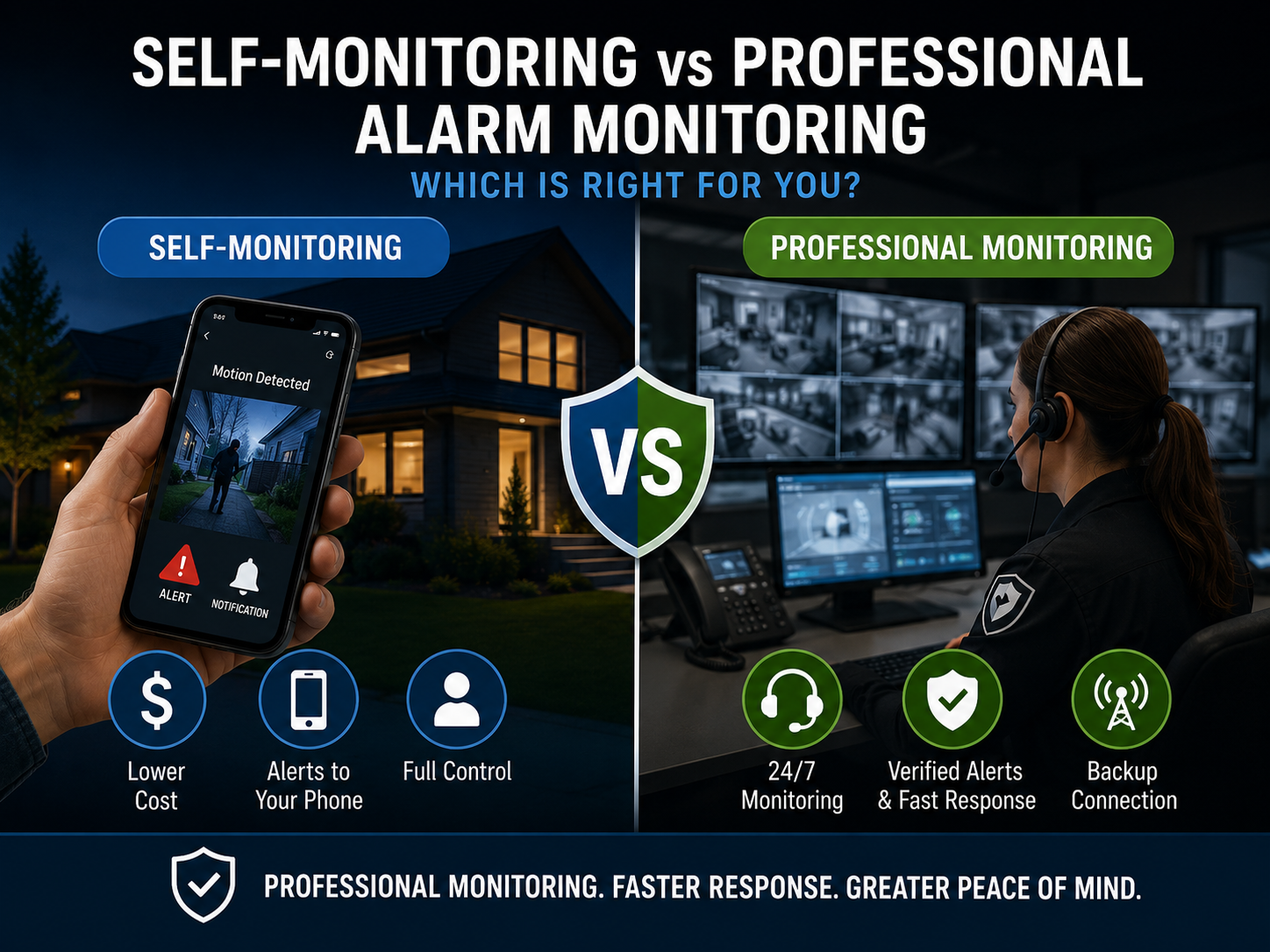
Choosing how to protect your home or business often comes down to one big decision: do you monitor the system yourself through a smartphone app, or do you pay for a professional monitoring service that watches it for you, 24/7? Both options use the same basic hardware — cameras, sensors, alarms — but what happens after an alert goes off is completely different. That difference can matter a lot more than most people realize, especially when a break-in happens at 3 a.m. and no one is looking at their phone.
Here's a clear, honest breakdown of both options so you can decide what actually fits your property, budget, and peace of mind.
What Is Self-Monitoring?
Self-monitoring means your security system sends alerts directly to you — through push notifications, text messages, or app alerts — and you're responsible for deciding what to do next. If a camera detects motion or a door sensor trips, you get a notification. You review the footage, and if it looks serious, you're the one calling 911.
Pros of self-monitoring:
- Lower monthly cost, often free or a few dollars a month
- No contract in many cases
- Full control over every alert
- Good for low-risk properties or as a supplement to other security
Cons of self-monitoring:
- You must be available and paying attention when an alert comes in
- No one calls police on your behalf — you have to do it yourself
- Notifications can be missed if you're asleep, driving, in a meeting, or your phone is on silent
- No backup if your internet or phone battery dies
What Is Professional Alarm Monitoring?
A professionally monitored system solves this. Because alarm monitoring services provide a live operator who confirms the intrusion through camera footage or audio before calling police, the alert gets flagged as verified, which triggers a priority response instead of sitting in a queue behind hundreds of false alarms. If speed matters to you during an actual emergency, this alone is often the deciding factor.
Pros of professional monitoring:
- Someone is always watching, even while you sleep or travel
- Faster, verified dispatch — many Canadian cities prioritize verified alarms over unverified ones
- Backup cellular connections keep the system online during a power or internet outage
- Often required by insurers for premium discounts, and by certain industries for compliance
Cons of professional monitoring:
- Monthly monitoring fee, typically ranging from around $30 to $90+ depending on the provider and package
- Usually involves a service agreement or contract term
Why Verified Monitoring Matters More Than Most People Think
This is the part that surprises a lot of homeowners and business owners: in many Canadian cities, including Vancouver, Calgary, and Edmonton, police no longer respond to unverified alarms right away. Too many false alarms from self-monitored or unmonitored systems have made "standard" alerts low priority for dispatch.
A professionally monitored system solves this. Because a live operator confirms the intrusion — through camera footage or audio — before calling police, the alert gets flagged as verified, which triggers a priority response instead of sitting in a queue behind hundreds of false alarms. If speed matters to you during an actual emergency, this alone is often the deciding factor.
Cost Comparison: Is Professional Monitoring Worth the Monthly Fee?
Self-monitoring is cheaper upfront and month to month, no argument there. But the real comparison isn't monthly cost — it's what you're protecting against.
- Insurance savings: Many Canadian insurers offer a discount, often in the 10–20% range, for properties with certified, professionally monitored alarm systems. Over a year, this can offset a meaningful chunk of the monitoring fee.
- Cost of a missed alert: If a self-monitored alert is missed while you're asleep or unreachable, the cost of a break-in, fire, or flood can far exceed years of monitoring fees.
- Peace of mind while away: For anyone who travels, works long shifts, or manages a business remotely, professional monitoring removes the pressure of needing to be constantly reachable.
Which One Should You Choose?
Self-monitoring may be enough if:
- You're almost always home or on-site and can respond immediately to alerts
- You're protecting a low-risk property, like a small apartment or a secondary space
- You want a low-cost starting point and may upgrade later
Professional monitoring is the better fit if:
- You own a business, rental property, or anywhere unattended for long stretches
- You travel often or can't guarantee you'll see every alert in real time
- You want faster emergency response and eligibility for insurance discounts
- You live in a city where police require verified alarms for priority dispatch
The Hybrid Approach
Many Canadian homeowners and business owners land on a middle ground: a system with professional monitoring for critical zones like entry points, alarms, and smoke/CO detectors, paired with self-monitoring access — like live camera feeds and instant push notifications — for everyday awareness. This gives you round-the-clock protection from trained operators while still letting you check in on your property whenever you want, from anywhere.
Final Verdict: Which is Best for You?
Self-monitoring puts you in the driver's seat, but it also puts the full responsibility on you, every hour of every day. Professional monitoring costs more monthly, but it means a trained operator is always watching, ready to verify an emergency and get help moving faster than you could on your own.
For most homeowners and especially for businesses, the combination of professional monitoring with self-monitoring access through a mobile app offers the strongest protection: constant coverage, faster response, and full visibility whenever you want it.
Not sure which setup fits your property? Contact us at 1-800-466-3348 to speak with a security specialist today from United Security and get a free, no-obligation assessment.